

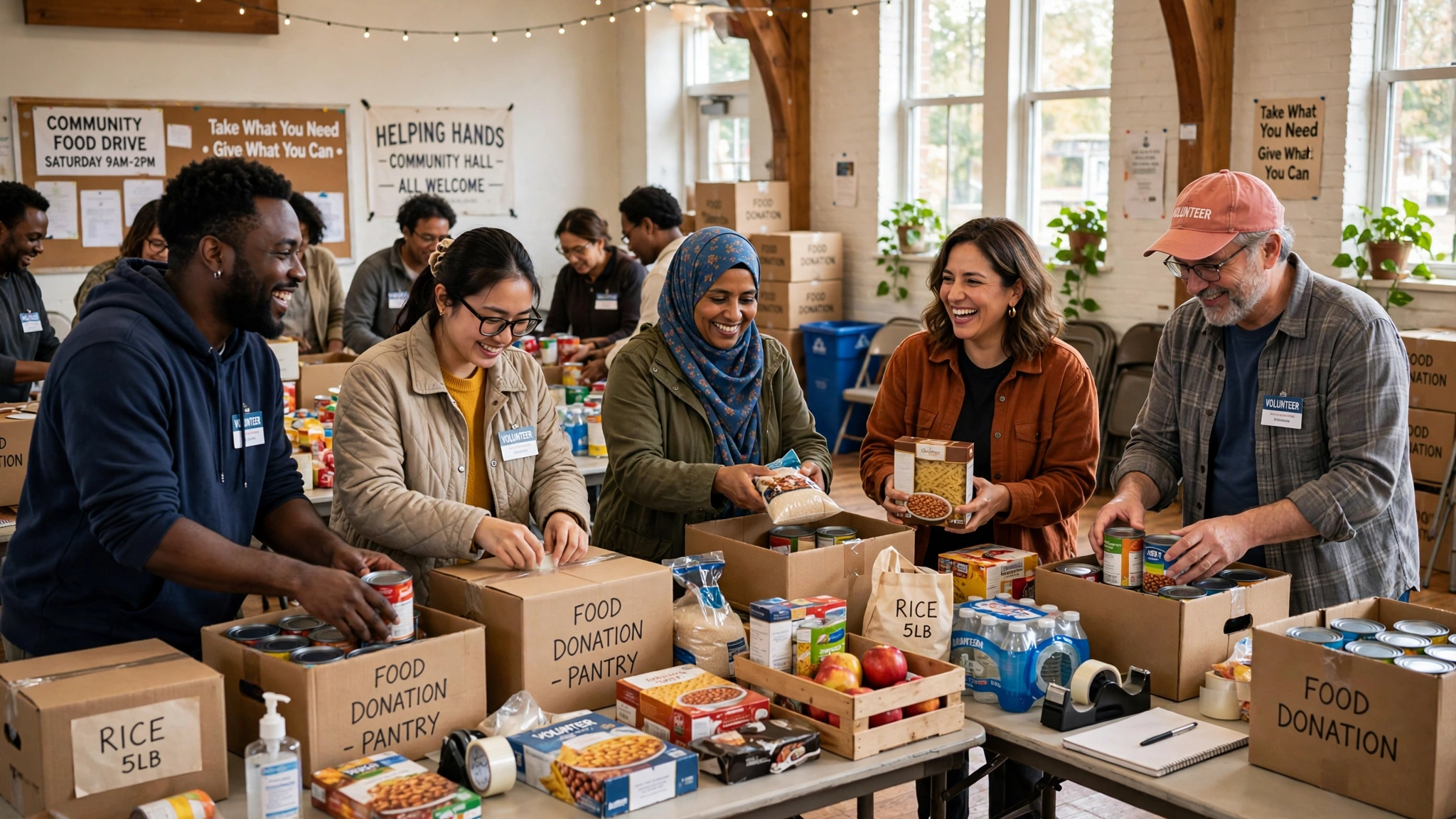
On a wet Tuesday evening in north London, a community hall that stood empty five years ago is full: volunteers packing food parcels, a homework club in the corner, two drivers waiting to take an elderly neighbour to a hospital appointment. Scenes like this are repeating across Britain in 2026 — and together they describe one of the most encouraging social trends of the decade: the return of organised neighbourliness.
A Quiet Army Is Growing
Charity sector bodies such as the NCVO, which represents voluntary organisations across England, have reported renewed energy in local volunteering after years of decline — particularly among younger adults and retirees. The pattern is not grand national campaigns but hyper-local ones: street-level WhatsApp groups that matured into visiting rotas, synagogue and church halls sharing space with food banks, school parents running uniform exchanges.
Faith communities have been central to the revival. Congregations already own the two assets volunteering runs on — trusted networks and physical space — and many have formalised what used to be informal kindness into reliable weekly services. The result is infrastructure that official services increasingly lean on, from warm spaces in winter to befriending schemes for the isolated.
Why Now?
The cost of living taught interdependence
Years of squeezed budgets showed families how thin the line is between coping and crisis — often one broken boiler or one lost shift. Communities that organised help early discovered the help ran in both directions: today’s volunteer is next month’s recipient, and everyone knows it. That reciprocity removed the stigma that once kept people from accepting support.
Loneliness became impossible to ignore
Public health guidance published through GOV.UK has increasingly treated social isolation as a health issue in its own right, particularly for older people. Volunteering answers it twice over — the visited gain company, and the visitors, researchers keep finding, gain purpose, structure and measurable improvements in their own wellbeing.
What Actually Works
The schemes that last share a design: small, regular, and matched to real skills. Retired tradespeople fix things. Accountants do charity bookkeeping — the same discipline that our readers apply when following the markets in pieces like our guide to trading support and resistance, turned to community ends. Students tutor; drivers drive; cooks cook. An hour a week, reliably given, beats a heroic one-off effort every time.
Good schemes also make starting effortless: a named coordinator, a simple rota, no long forms. The first shift is the hardest to arrange and the easiest to repeat.
How to Join In
Start where you already are. Your congregation, school, sports club or street almost certainly has a rota with gaps in it. Offer the specific thing you can do, at the specific time you can do it, and let the organiser fit you in. If nothing exists locally, national volunteer-matching services can place you within days.
Britain’s communities are often described as fraying. Spend an evening in that north London hall, though, and a different picture emerges — of neighbours quietly reweaving the net, one parcel, one lift, one visit at a time. It is not nostalgia. It is maintenance, done by hand, and it is working.
