

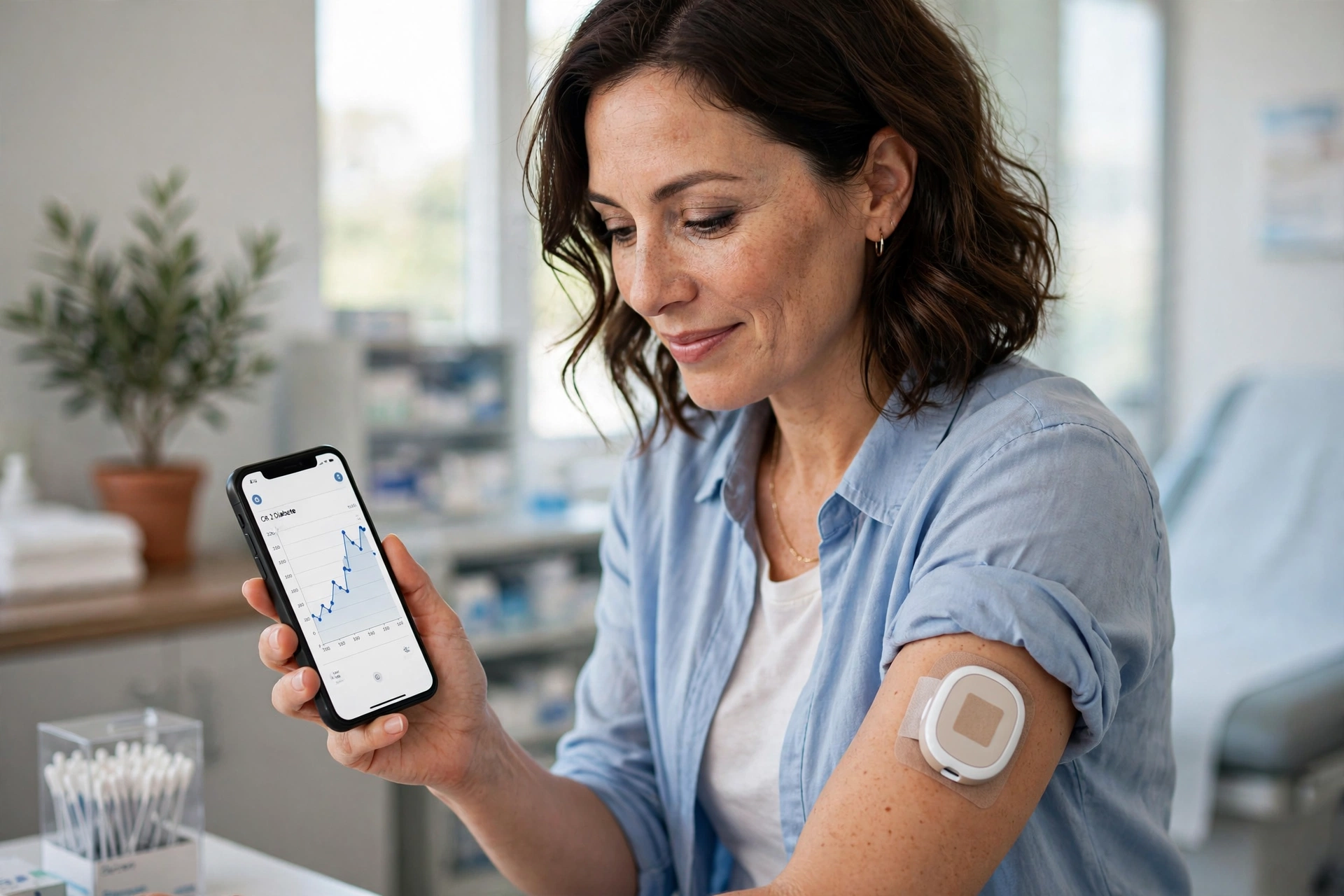
Continuous glucose monitors, the small wearable sensors long associated with insulin treatment, can make a meaningful difference for a much wider group of patients. In the largest clinical trial of its kind, published in the New England Journal of Medicine, adults with type 2 diabetes who did not use insulin spent approximately five more hours a day in their target blood sugar range when they used a monitor than when they relied on standard care.
What the Trial Found
The result matters because time in range is increasingly regarded as one of the clearest measures of day-to-day diabetes control. A traditional HbA1c test gives an average over several months, but it cannot show the daily peaks after meals or the dips that leave people feeling unwell. A sensor worn on the arm or abdomen measures glucose continuously, sending readings to a phone or receiver and revealing patterns that finger-prick tests often miss.
Researchers behind the study, reported by the University of Colorado Anschutz Medical Campus, say the scale of the trial is what sets it apart. Earlier work on glucose monitors focused mainly on people using insulin, who face the sharpest swings. This study asked a simpler and more practical question: does seeing your glucose in real time help even when your treatment is tablets, diet and activity alone? The answer, on this evidence, is yes.
Why Seeing the Numbers Changes Behaviour
Clinicians say the benefit is partly behavioural. When a patient can see a glucose rise after a particular breakfast, or a fall after a short walk, advice stops being abstract. Small experiments become possible: a different portion, a walk after dinner, a change in the order of foods on the plate. Over weeks, those small adjustments add up to hours more each day within the healthy range.
That feedback loop also helps doctors. Instead of adjusting medication on the basis of a single quarterly average, care teams can see whether a drug is working at night, after meals or during exercise, and can spot problems earlier. The New England Journal of Medicine, which published the trial, is among the most closely watched medical journals in the world, and publication there is likely to strengthen the case for wider access to the devices.
Who Could Benefit Most
Type 2 diabetes affects hundreds of millions of people worldwide, and most of them do not use insulin. If monitors help even a fraction of that group avoid the long-term complications linked to poor control — damage to eyes, kidneys, nerves and blood vessels — the savings in suffering and healthcare costs could be substantial. Patients at risk of hypoglycaemia, those changing medication, and people whose HbA1c remains above target despite treatment may be among the first candidates clinicians consider.
There are, however, real obstacles. Sensors are consumables that must be replaced regularly, and in many health systems they are funded only for narrow groups of patients. Cost-effectiveness will be central to the debate that follows this trial: payers will want to know whether five extra hours in range each day translates, over years, into fewer complications and hospital visits. Advocates argue the trial provides exactly the kind of large, rigorous evidence that funding decisions require.
What Patients Should Do Now
Diabetes specialists caution that a monitor is a tool, not a treatment in itself. The readings only help if patients and clinicians act on them, and nobody should change medication without medical advice. People with type 2 diabetes who are curious about the technology can raise it at their next appointment, ask whether their readings would change any decisions, and check what their insurer or health service currently covers.
Still, the direction of travel is clear. Glucose monitoring is moving beyond insulin users, driven by better sensors, simpler apps and now stronger trial evidence. For millions of people who manage type 2 diabetes with tablets and lifestyle changes, five more hours a day in a healthy range is not a minor statistic. It is a daily, measurable improvement — and this study suggests it is achievable with a sensor no bigger than a coin.
