

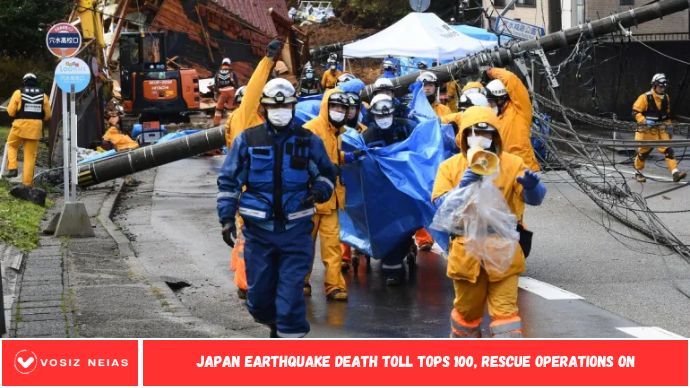
Japan Earthquake Death Toll Tops 100 How does a country known for its earthquake readiness still face such tragic losses? On January 1, 2024, Japan experienced one of its deadliest natural disasters in nearly a decade. A powerful 7.6-magnitude earthquake struck the western coastline, toppling buildings, severing roads, and triggering widespread fires and landslides.
Now, the death toll has crossed 100, and with more than 200 people still missing, search and rescue teams are racing against time and harsh winter conditions.
The tragic toll from the New Year’s Day earthquake in Japan has now climbed past 100, as rescue teams and local residents work tirelessly to uncover bodies beneath the wreckage.
Hopes of finding additional survivors are fading fast in the aftermath of Japan’s deadliest earthquake in nearly eight years. As of Saturday, authorities report that more than 200 people remain unaccounted for.
The 7.6-magnitude earthquake, which struck Japan’s western coast, caused widespread destruction—crippling infrastructure, cutting off roads, and leaving over 23,000 homes without power across the Hokuriku region.
By Saturday afternoon, officials confirmed 16 more fatalities in Wajima city and Anamizu town, bringing the official death toll to 110, according to reports from Ishikawa Prefecture.
Wajima has suffered the heaviest loss of life, with 59 confirmed deaths, followed by Suzu, which has reported 23 casualties. In total, the disaster has left over 500 people injured, including at least 27 with serious injuries.
One Wajima resident, Hiroyuki Hamatani, described the shock of the event. “We were celebrating New Year’s Day with family when the quake struck. It was sudden, terrifying,” said the 53-year-old. “Our home is still standing, but it’s no longer livable. I can’t even think about what comes next.”
Japan sits atop a complex web of tectonic boundaries, where four major plates intersect, making it one of the most earthquake-prone countries in the world. While it experiences hundreds of minor tremors annually, few cause significant damage.
This recent quake marks the deadliest seismic disaster in Japan since 2016, when twin earthquakes in Kumamoto claimed 276 lives. It is also a stark reminder of the country’s vulnerability, echoing memories of the 2011 catastrophe, when a magnitude 9 undersea quake triggered a devastating tsunami and nuclear meltdown in Fukushima, killing over 18,500 people.
What Happened: The Earthquake at a Glance
A sudden and violent tremor struck Ishikawa Prefecture and surrounding areas just after noon, shaking the nation as the quake reached a magnitude of 7.6. The worst-hit cities include Wajima, Suzu, and Anamizu, where hundreds of homes were flattened.
Key Points:
- Magnitude: 7.6 on the Richter scale
- Location: West coast of Japan, near Noto Peninsula
- Time: January 1, 2024, afternoon
- Initial Tsunami Warning: Issued and later lifted
- Aftershocks: More than 130 recorded within 48 hours
Rising Death Toll and Search for the Missing
As of now, over 100 people are confirmed dead, and the number may rise as more debris is cleared. Search teams, often digging by hand, are navigating collapsed buildings and landslides to find survivors.
Statistics So Far:
- Deaths: 110 confirmed
- Missing: Over 200 still unaccounted for
- Injured: More than 500 treated in hospitals
- Evacuated: Approximately 30,000 residents displaced
- Power outages: 23,000+ households without electricity
Rescue Operations Face Weather and Infrastructure Hurdles
Thousands of rescue workers, including the Japanese Self-Defense Forces, firefighters, and volunteers, are working under extreme pressure. Snowfall and freezing temperatures are making access even more difficult.
Major Challenges:
- Blocked roads due to landslides
- Damaged communication and electricity infrastructure
- Cold temperatures slowing down operations
- Limited access to remote mountainous areas
Despite this, over 1,000 people have already been rescued, some pulled from beneath collapsed buildings after nearly two days.
Government and Public Response
The Japanese government has declared a state of emergency and allocated significant funds for immediate relief and rebuilding. Prime Minister Fumio Kishida urged residents to remain calm and cooperate with emergency services.
Emergency Measures Include:
- Deployment of 10,000+ rescue personnel
- Temporary shelters and food distribution
- Health and mental care support for evacuees
- Power and water restoration task forces
The Road to Recovery: What’s Next?
Recovering from this disaster will take months, if not years. Engineers are already assessing damaged roads, bridges, and buildings. The government is also discussing stricter seismic reinforcement for older structures in rural areas.
Key Recovery Priorities:
- Reuniting missing persons with families
- Providing long-term housing for displaced residents
- Rebuilding infrastructure safely and sustainably
- Psychological support and trauma care
FAQ
1. What caused the earthquake in Japan?
A tectonic shift along the Noto Peninsula fault line triggered the 7.6 quake.
2. How many people have died so far?
The confirmed death toll has crossed 100, with many still missing.
3. What areas were most affected?
Ishikawa Prefecture, especially Wajima and Suzu, suffered the most severe damage.
4. Are rescue operations still underway?
Yes, search and rescue teams are active, but snow and landslides are slowing them down.
5. How many are displaced or homeless?
Over 30,000 people have been evacuated from the region.
6. What is being done to help survivors?
Rescue, shelter, food, and medical care are being coordinated by government agencies and NGOs.
Conclusion
The earthquake in Japan is a stark reminder of the unpredictability of nature—even in a nation known for disaster preparedness. With over 100 lives lost and many still missing, the coming days will be critical for search efforts and survival. While the situation remains dire, the swift response of rescue teams and community resilience offers hope.
