

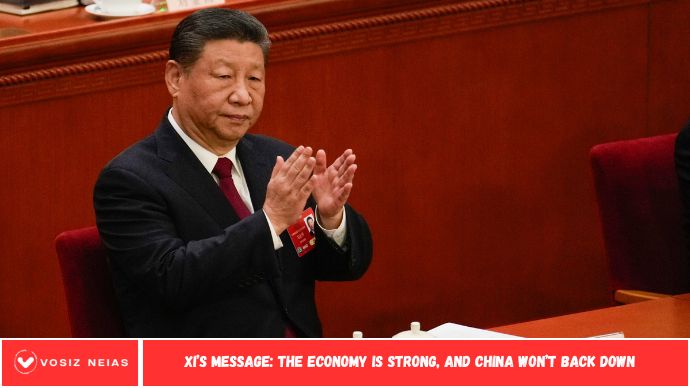
Xi’s Message: The Economy Is Strong, and China Won’t Back Down China’s economic narrative is shifting with President Xi Jinping reaffirming confidence in national growth and issuing a clear message: China will not retreat. In the face of Western scrutiny, trade tensions, and domestic economic headwinds, Xi’s address promotes resilience, self-reliance, and long-term strategic planning. This article explores the state of China’s economy, its response to challenges, and the implications for global stakeholders.
Amid sluggish growth and rising tensions with the United States, China’s top leaders sought to project a sense of confidence in the country’s economic future. At the opening of the annual session of China’s rubber-stamp legislature, Premier Li Qiang, second only to Xi Jinping, outlined a goal to expand China’s economy by “around 5 percent” this year. While acknowledging the economic challenges ahead and the “arduous efforts” required to meet these targets, Li remained optimistic about the country’s long-term prospects, emphasizing that the core trajectory of China’s economic growth remains intact. “The giant ship of China’s economy will continue to cleave the waves and sail steadily toward the future,” he said.
Introduction: A Defiant Signal Amid Global Doubts
“China’s economy is strong and improving,” President Xi Jinping declared in a recent high-profile address aimed not just at domestic audiences, but the world. With foreign investors increasingly wary and global rivals scrutinizing China’s trajectory, Xi’s message serves as both reassurance and warning: China isn’t backing down—economically or geopolitically.
This article breaks down:
- What Xi’s message reveals about China’s economic outlook
- How China is positioning itself against Western influence
- Key economic indicators driving confidence
- Strategic priorities shaping China’s next phase
Economic Resilience Despite Pressures
Slowdown, Not Collapse
While China’s growth rate has moderated, it is far from stalling. In 2024, China’s economy grew 4.9% year-over-year, beating market expectations. Industrial output, retail sales, and infrastructure investment remain robust, driven by state-backed initiatives and renewed consumer confidence.
Managing Youth Unemployment
One of the country’s most pressing domestic issues—youth unemployment, which hovered near 21% in 2023—is being targeted through vocational programs and private sector incentives.
Strategic Sectors Driving Growth
1. Technology and AI
Xi has doubled down on tech self-reliance, pushing for advancements in semiconductors, AI, and digital infrastructure. The government allocated over $280 billion for innovation hubs in 2024 alone.
2. Green Energy and EVs
China leads the world in EV production and clean energy deployment. Over 60% of global EV battery production now comes from Chinese firms like CATL and BYD.
3. Belt and Road Initiative (BRI)
Despite criticism, BRI continues to expand. Xi highlighted its role in strengthening global economic influence while ensuring secure export routes for Chinese goods.
Xi’s Political Messaging and Global Posture
Xi’s speech carried a strong political undertone. His core message emphasized:
- National sovereignty and non-interference
- Resistance to decoupling from the West
- Confidence in domestic reform and market opening
This comes at a time when the U.S., EU, and Japan have increased scrutiny over China’s trade and industrial practices, particularly in green tech and data security.
What This Means for Global Markets
Investors and policymakers are watching closely. Xi’s posture signals:
- Less likelihood of major policy softening toward Western economic demands
- Continued state-driven support for core industries
- A pivot toward emerging markets and domestic consumption to offset reliance on Western economies
Conclusion
Xi Jinping’s message is clear: China is not only enduring the global slowdown—it’s actively shaping the next economic era on its own terms. Whether through tech innovation, green energy, or geopolitical recalibration, China’s path forward reflects both ambition and assertiveness. For global businesses and governments, understanding this posture is crucial to navigating the next chapter of international economic competition.
FAQs
1. Is China’s economy actually growing in 2024?
Yes, China’s GDP grew by approximately 4.9% in 2024, exceeding many analyst expectations.
2. What sectors are key to China’s economic strategy?
Tech, green energy, infrastructure, and global logistics (via BRI) are major pillars of growth.
3. How is China addressing youth unemployment?
Through expanded vocational training and private-sector job creation programs.
4. What is Xi’s stance on Western economic pressure?
Xi emphasized non-retreat and sovereignty, rejecting Western decoupling strategies.
5. Are foreign investors still active in China?
Interest remains cautious but steady, especially in sectors tied to AI, renewables, and EVs.
6. How does the Belt and Road Initiative impact China’s economy?
It enhances trade connectivity and secures long-term export channels for Chinese companies.
