

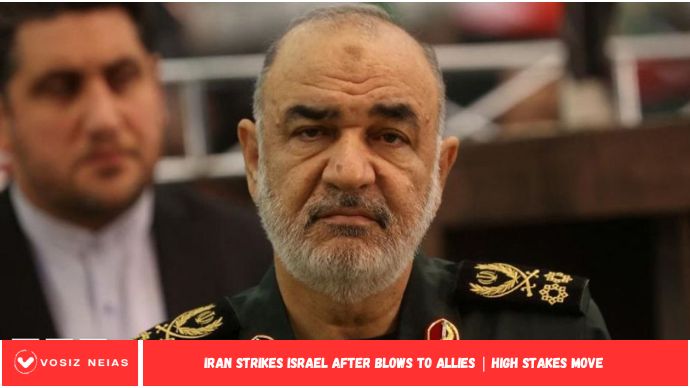
Iran’s recent missile attack on Israel followed major losses to its regional allies. This article explores why Tehran chose escalation, the strategic fallout, and what it means for the Middle East. Key keywords: Iran Israel attack, Middle East escalation, Iran allies loss, Israel retaliation.
Iran’s top military leader, Major General Hossein Salami, commander-in-chief of the Islamic Revolutionary Guard Corps (IRGC), was shown in a video released by Iranian media directing a major missile assault on Israel. The footage, reportedly filmed inside a command center, showed Salami standing before a large banner as he gave the order by telephone to launch approximately 200 ballistic missiles.
The backdrop prominently displayed images of three key figures whose deaths Iran cited as justification for the strike: Hamas political leader Ismail Haniyeh, killed in Tehran in July in an attack Iran attributed to Israel; Hezbollah Secretary-General Hassan Nasrallah; and Brigadier General Abbas Nilforoushan, a senior IRGC Quds Force commander. Nasrallah and Nilforoushan were both killed in a reported Israeli airstrike in Beirut the previous week.
According to the IRGC, the missile barrage included advanced Fattah hypersonic missiles, which allegedly reached Israeli territory within 12 minutes. The force claimed that several high-value targets were struck, including three Israeli airbases and a building said to house Mossad intelligence operations.
However, the Israel Defense Forces (IDF) countered that the vast majority of incoming missiles were successfully intercepted by Israel’s multilayered defense systems, supported by allied forces, notably the United States. The IDF acknowledged only a limited number of impacts in central and southern regions of the country.
In the aftermath of the attack, a massive banner appeared in Tehran’s Palestine Square. It showed a swarm of missiles descending on structures shaped like the Star of David, accompanied by a bold slogan in Farsi: “The beginning of the end of Zionism.”
Introduction: A Sudden Strike in the Shadow of Setbacks
On October 1, 2024, Iran launched more than 200 ballistic missiles and drones at Israel in a bold and unprecedented direct strike. The attack didn’t occur in a vacuum. It came after Israel allegedly eliminated top leaders from Iran’s proxy network — Hamas, Hezbollah, and even Iran’s own Islamic Revolutionary Guard Corps (IRGC). With these humiliating losses fresh, Iran’s move was seen as a high-stakes gamble to reassert dominance and save face.
This article unpacks the motivations behind Iran’s move, how the conflict escalated, and what this confrontation means for the future of Middle Eastern geopolitics.
1. What Triggered the Attack? Iran’s Proxy Network Under Siege
Iran has long relied on regional allies and proxy forces to challenge Israel without direct conflict. But in mid to late 2024, Israel systematically dismantled this strategy:
- Hamas leader Ismail Haniyeh was assassinated in Tehran.
- Hezbollah chief Hassan Nasrallah was killed in Beirut.
- IRGC commander Abbas Nilforoushan died in a targeted strike, also in Beirut.
These losses were devastating to Iran’s influence in the region. Tehran faced a stark choice: retaliate directly or appear weak.
Key Point: Iran’s missile strike was less a show of strength and more a response to a crumbling proxy structure.
2. The Attack: Scope, Targets, and Results
On October 1, 2024, Iran launched:
- Over 200 missiles and drones
- Targeting Israeli airbases, radar installations, and intelligence hubs
While Israel’s Iron Dome and David’s Sling missile defense systems intercepted about 85% of the projectiles, some struck:
- A military base in southern Israel
- An air defense radar station near Jerusalem
- Civilian casualties were limited but politically significant
Military analysts suggest the strike had more symbolic value than tactical effect. Yet it shattered long-standing norms, as Iran rarely attacks Israel directly.
3. Israel’s Retaliation: Operation Days of Repentance
On October 26, 2024, Israel responded with “Operation Days of Repentance”, targeting Iran’s core infrastructure:
- Missile development sites in Esfahan and Mashhad
- Air defense units around Tehran and Shiraz
- Suspected underground facilities in Qom
The damage severely weakened Iran’s aerial defense and sent a clear message: future aggression would bring direct consequences.
Takeaway: Israel’s retaliation reasserted military superiority and showed a willingness to escalate — even inside Iranian borders.
4. Regional Fallout: New Tensions, Old Alliances Tested
Iran’s decision had ripple effects across the Middle East:
- Saudi Arabia and UAE condemned the escalation, fearing regional destabilization.
- Iraq and Syria, heavily influenced by Iran, became potential staging grounds.
- Egypt and Jordan called for immediate diplomacy to prevent broader conflict.
According to a 2025 report by the Middle East Policy Council, over 73% of Arab League nations expressed concern that the confrontation could spark a regional war if unchecked.
Strategic Implication: Iran’s move didn’t unite the region against Israel — instead, it isolated Tehran further.
5. Was This a Strategic Mistake for Iran?
Some analysts argue Iran’s decision was necessary to preserve deterrence. But others view it as a costly miscalculation, especially considering:
- The limited military success of the strike
- The crippling retaliation from Israel
- The further erosion of support from Arab neighbors
Latest intelligence assessments suggest Iran’s missile production capacity may now be reduced by nearly 40%, setting back its capabilities by years.
Bottom Line: Iran showed its hand, but lost a key element — strategic ambiguity.
Conclusion
Iran’s attack on Israel marked a turning point — not just in terms of direct military action, but in how Middle East power dynamics operate. Once content to fight through proxies, Tehran is now exposed. And while the strike may have satisfied internal pressures, it left Iran strategically weakened and regionally isolated.
FAQs
1. Why did Iran attack Israel directly?
To respond to the assassinations of key Iranian allies and reassert regional deterrence.
2. What damage did the Iranian missiles cause?
Most were intercepted; some hit Israeli military infrastructure, causing limited casualties.
3. How did Israel respond to the attack?
With a multi-phase air operation targeting Iranian missile sites and air defenses.
4. What role did Iran’s allies play?
They remained mostly passive, weakened by leadership losses and cautious of escalation.
5. How did Arab nations react?
Most expressed concern, urging de-escalation and distancing themselves from Tehran.
6. What’s next for Iran-Israel relations?
High alert continues, but both sides face pressure — internal and external — to avoid full-scale war.
